Showing posts with label CBM. Show all posts

Tuesday, December 7, 2021

Types of Equipment Maintenance Strategies

Condition-based maintenance (CBM or CBM+) is a strategy of performing maintenance on a machine or system only when there is objective evidence of need or impending failure. CBM is enabled by the evolution of key technologies, including improvements in - sensors, microprocessors, digital signal processing, simulation modeling, multisensor data fusion, reliability engineering, Internet of Things (IoT) connectivity, data warehousing, cloud computing, machine learning (ML), artificial intelligence (AI), and predictive analytics. CBM involves monitoring the health or performance of a component or system and performing maintenance based on that inferred health and in some cases, predicted remaining useful life (RUL). This predictive maintenance philosophy contrasts with earlier ideologies, such as corrective maintenance — in which action is taken after a component or system fails — and preventive maintenance — which is based on event or time milestones. Each involves a cost tradeoff. Corrective maintenance incurs low maintenance cost (minimal preventative actions), but high performance costs caused by operational failures. Conversely, preventative maintenance produces low operational costs, but greater maintenance department costs. The result is the additional hidden cost associated with disposing of components that still retain significant remaining useful life. Such early retirements also drive more demand for spares and higher procurement costs over the life cycle.
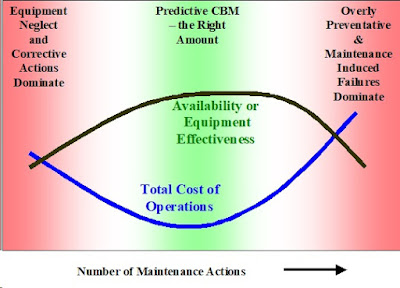
 
Carl Byington, CBM, PHM Design
Operational availability (military) or overall equipment effectiveness (industrial) is also affected by maintenance choices. Overly corrective or overly preventive maintenance strategies can reduce true availability through too much downtime due to maintenance. On the corrective side, running to failure or near failure typically leads to more significant operational issues and consequential damage. Lost production, downtime, and more significant maintenance often result. On the preventive side, the equipment is often unavailable because it is being more frequently maintained than optimally required in order to conservatively prevent failures. There is also a greater likelihood of maintenance-induced failures, which can have a negative effect on cost and availability. The more one disassembles or modifies well functioning equipment, the greater the chance that one will introduce a new problem or confounding issue.

Implementing better maintenance practices is driven by the desire to reduce the risk of catastrophic failures, minimize maintenance costs, maximize system availability, and increase platform reliability. These goals are desirable for aircraft, ships, ground vehicles, and industrial manufacturing of all types. Given that maintenance is a key cost driver in military and commercial applications, it is an important area in which to focus research and development efforts and drive continued engineering improvements.

About the Author

Carl Byington became an expert in prognostics and health management (PHM) technologies and next-generation condition-based maintenance plus (CBM+) solutions. You can view some of Carl’s past work on his Slideshare and Researchgate pages. Also see PHM Design company, located in the Atlanta, GA area, services offered for some potential engagement roles.


Wednesday, November 24, 2021

Advanced Oil Condition and Debris Analysis


Oil elemental analysis, oil quality characteristics, and debris

The specific oil quality contamination events that are the most dominant failure modes relevant to the target lubrication system are: water contamination, addition of incorrect oil, fuel dilution, and degraded oil. The current method of determining dominant failure modes in wear debris and oil quality is periodic oil sampling, and off-line testing, where the following standard  oil analysis tests are performed on oil4:

Elemental Analysis / Oil Debris

Atomic emission spectroscopy (AES) – wear debris and dirt

LaserNetFines (LNF) – silhouette of particle, plus size and shape

Ferrography – particle size and shape and sorted by ferrous / non-ferrous

Oil Quality

FTIR (bench and handheld) – lubricant condition and contamination

Viscometer – lube viscosity

Crackle test – water contamination

Karl Fisher – water contamination

Flashpoint – fuel contamination

Fuel meter – fuel contamination

Particle counting – for hydraulic cleanliness – fine particulate contamination

In order to realize a sensor that can enhance the timeliness and overall effectiveness of periodic oil sampling for corrective maintenance actions, the on-line sensor must provide data that is similar in concept or utility to many of these tests. 

Oil Debris Sensing

Oil debris is part of the end-of-life process of a mechanical component, such as a gearbox or oil-wetted bearing. The sensor must therefore be capable of correctly identifying the wear particulate produced by gear tooth wear or bearing spall. Correctly identifying the size and type of wear metals provides an indication of the component that is failing as well as the severity of the failure. Commercially available oil debris monitor (ODM) have been developed with consideration of these critical detection requirements.

An on-line inductive sensor typically detects nearly 100% of ferrous (Fe) and some non-ferrous (non-Fe) metallic wear debris particles above a minimum threshold size (typically 100-200 µm). The sensor counts each particle, determines particle makeup (Fe or non-Fe), and sizes the particles into bins (200-300 µm, 300-400 µm, etc.). The total mass of debris is updated in real-time. Size, count, mass, and makeup of wear particles have been shown to provide condition indication for aircraft bearings and provide diagnostic and prognostic information about bearing health and remaining useful life and allows for on-line discrimination of component damage vs. normal wear debris.

Additional Resources

Please check out some of my earlier publications on these capabilities at:

https://www.machinerylubrication.com/Read/138/real-time-oil-analysis

https://www.sbir.gov/node/5323

https://www.navysbir.com/06_1/123.htm

https://www.slideshare.net/Carl-Byington/cbm-sensing-by-carl-byington-of-phm-design 

About the Author:

Carl Byington developed and patented oil sensor technologies for Impact Technologies, Sikorsky Aircraft, and Lockheed Martin. Carl Byington became an expert in prognostics and health management (PHM) technologies and next-generation condition-based maintenance plus (CBM+) solutions. He currently consults in these technical areas at his PHM Design company, located in Georgia. 


Wednesday, September 8, 2021

CBM Program for US Army Aircraft


A former Rochester, NY consultant, Carl Byington emphasizes data and analytics-based approaches at PHM Design, LLC in Atlanta, GA. He works with clients to implement predictive analytics to maximize operational and maintenance efficiency. Well published in his field, Carl Byington presented the condition-based maintenance (CBM) of the United States Army aircraft systems at an American Helicopter Society (AHS) specialists’ meeting.

A CBM program involves moving from part replacements performed at defined intervals to maintenance performed upon “evidence of need". With the context of the Army’s CBM+ plan, this requires a move away from “time before overhaul” (TBO) protocol that traditionally defines schedules for military vehicle component maintenance. It also suggests an ability to move away from dedicated inspection and test flight maintenance events.

According to the paper, major obstacles in CBM adoption include the limited ability of digital source collectors (DSC) and health and usage monitoring systems (HUMS) to diagnose component faults early. Issues include condition indicators and sensors’ sensitivity to operating/environmental conditions, observability of specific failure modes, and inherent signal to noise ratio. Fleet-wide diagnostic thresholds to action are also difficult to implement, with uncertainties arising in detecting existing and progressive damage or wear among individual aircraft variations of use. Implementing prognostics on faulty or degrading components is inherently a significant endeavor, with validating and verifying such systems a remaining challenge.

The paper presents tools that can improve data monitoring, boost diagnostics, and enable prognostics to be implemented in ways that support a better transition to CBM. The realizable benefits are substantial. Detection of faults in their early stages provides an opportunity to order parts, schedule personnel, shutdown the equipment before serious damage occurs, and minimize the disruption to production and missions. Furthermore, insight gained from better diagnostics reduces uncertainty regarding the “health” of critical internal drivetrain components and allows for the safe reduction of some preventive maintenance and inspections. In other words, maintenance is performed only when necessary. As we extend such capability into predictive prognostics technology, often enabled now by machine learning (ML) and artificial intelligence (AI) techniques, we can realize even greater maintenance and logistics benefits.